The Breath of the Living Universe
Il Respiro dell'Universo vivente
The Cosmos – what originates from Chaos but differs from it because it expresses the possibility of ordering and organising – is the archetypal model humankind follows in its actions, directing matter and energy towards its projects.
The striving for the absolute, for perfection and totality, is an irrepressible drive of the human psyche which, though destined to perpetual frustration, archetypally manifests the idea of perfection and completeness…
Dario Valcarenghi, Storia del Kilim Anatolico, Electa, Milan, 1985, p. 39
Since the cosmic idea of rebirth arose from observing the stars, the first mythical image of the world must have been that of a Star… Cf. Jutta Voss, La Luna Nera, Red Edizioni, Como, 1996, p. 165
This happened at a time when the prevailing image was of a world lived with a deep awareness of a cyclical order of life, death and rebirth, in continuous regeneration – very different from the later, linear one…
The symbol of the Star represents the authority of a female symbolic order, corresponding to a deity honoured for her ability to give birth to and perpetuate life in all its forms.
…
Because of its immeasurable symbolic power, the Star has suffered a fate similar to that of other important symbols, such as the cross or the swastika.
Representing the eternal descent of a people, it has sometimes been borrowed: it appears universally in fairy tales as a defence against persecution and evil in general; the circle of dots, pearls or diadem of stars in so many ancestral representations of the female deity – a star with 5, 6 or 8 points – becomes, for example, the crown of stars of the Madonna…
But more often the Star has been usurped, and its meaning transformed in a patriarchal sense – for example in the military sphere, where it has been associated with valour in war: it appears on military uniforms in greater numbers the more blood has been shed.
Despite the distortion and perversion of its meaning, the star nonetheless remains a sign of authority in the world. Cf. Jutta Voss, op. cit., p. 172
The Star of Vajravarahi and the Star of Hacilar
The symbolic representation of the Cosmos
The Star of Vajravarahi, like so many other sacred ancestral symbols usurped and modified in a patriarchal sense, has become a symbol of territorial possession.
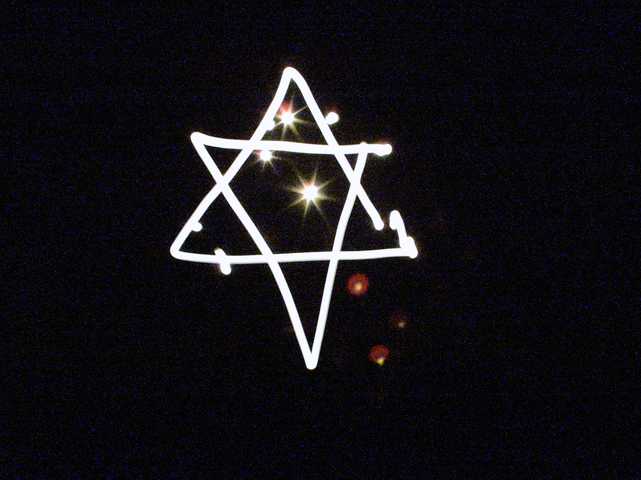
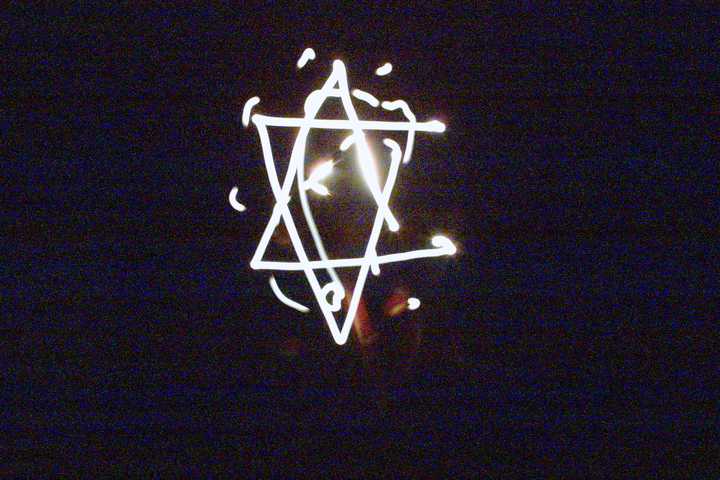
In fact the star known as the Star of David and/or Seal of Solomon had existed for a very long time: it was the red six-pointed star, the mandala of the pre-Vedic goddess Vajravarahi, already three thousand years ago.
Vajra means diamond, which in Asia is also a symbol of the star.
Red, the colour associated with menstruation – once taboo only in a sacred sense, not yet degenerated into the concept of impurity – was a symbol of life in continuous regeneration…
The Star of Vajravarahi is formed by two triangles, one pointing upwards and one downwards; together they form a six-pointed star in which the energy turns outwards: starting from the centre it seems to expand, to explode all around itself.
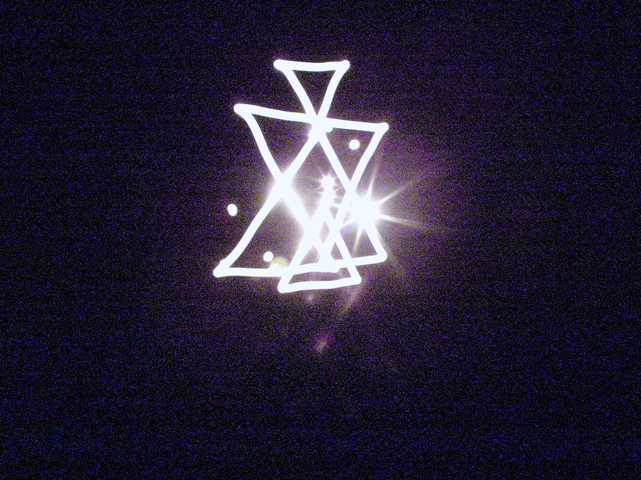
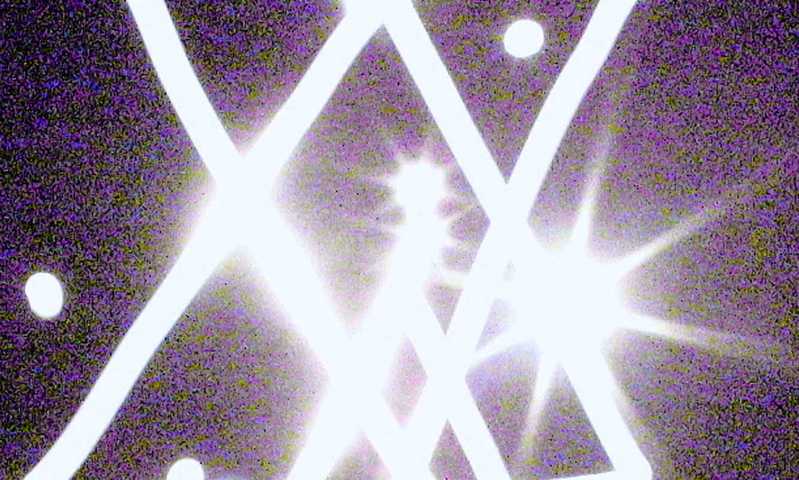
The Star of Hacilar – an ancestral symbol, present in archaeological evidence dating back about 8,000 years – bears witness to our ancestors’ perception of that com-union which makes the human being one with the immense cosmos.
It too is formed by several triangles, but the points turn inwards: the feeling is one of gathering, of reflection, almost of implosion on an energetic level.
We see the perfect correspondence with the fundamental rhythm of contraction and expansion underlying every vital process – breathing, the beating of the heart, and so on.
It is the cosmic rhythm, mirrored in that of all living organisms.
The two stars lead us back to the original structure of all harmony and perfection: the living Universe.
They embody ordered, harmonious totality, completeness: the duality they momentarily signal is in fact overcome by the idea of infinity expressed by their shared, vibrant pulse.
A work in synergy with the poem of the same title published in the book UNIVERSI.
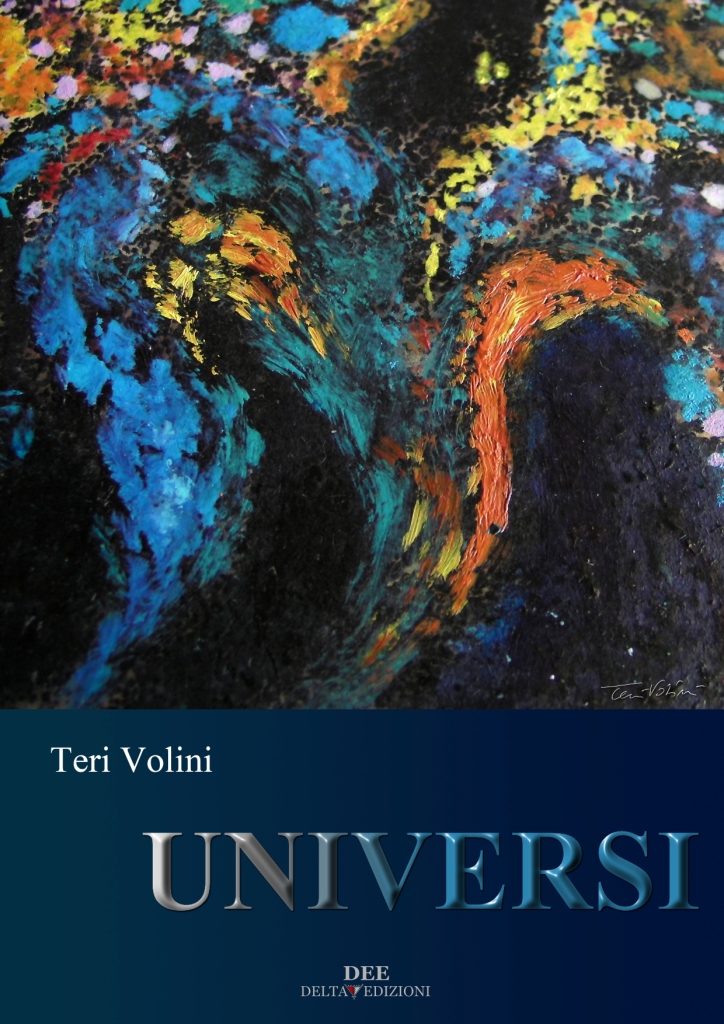
Some of Teri’s poems act as a counterpoint to her paintings or performances. Heightening feeling and vision nonetheless leaves the different modes of expression independent of one another: the poems are not meant to describe the other works, nor are the latter meant to illustrate the former. What matters is the balance, the happy union that is created, the synergy that arises, in that attempt to achieve the harmony and beauty at the heart of all Teri’s research.