Madonnas and Witches in Castelmezzano
Madonne e Streghe a Castelmezzano
The Madonna of the Ascension in Castelmezzano
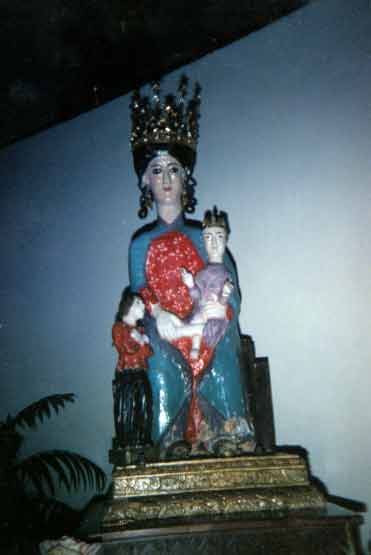
And so we come to the Madonna known as “of the Ascension”. She stands outside the village, in a small church nestled among the rocks. Just after leaving the tunnel carved through the Arm rocks that leads into Castelmezzano, it is high up on the right, along the recently paved path; the key must be asked for in the village from a family that “looks after” it, that is, is responsible for it and devoted to it. In the past this church was used to bury the dead, before the cemetery was built.
The Madonna of the Ascension is in truth a “little Madonna”, small in height, almost entirely covered by a cloak of blue satin embroidered in gold. A pity – despite the excellent devotional and affectionate intentions of those who sewed, embroidered and placed it on her (among them, in the past, my mother and my aunt Marietta) – because the cloak intrusively covers the beauty of the original image, hiding it almost completely.
The Madonna would have no need of it, since she already has, painted directly on her wooden body, a dark red dress with schematic cream-coloured dots or flowers; the same goes for the Child in her arms.
At her feet is a praying figure. Legend tells of a young sailor who supposedly accompanied the Madonna’s sea voyage to our shores… Beyond this legend – which nonetheless has the merit of conveying the distant origin of the statue, and so of giving her the very particular character of a “travelling” or perhaps, more precisely, “migrant” little Madonna, like the people who brought her with them… – she has features that make her not only fascinating and attractive but absolutely unique… First of all, her “reduced” size tells us that she was made on purpose not to stay “still” in one place, but to move together with the devotees she protected – people who habitually travelled, or were driven to by various circumstances (wars, invasions by other peoples, famines, pilgrimages, etc.).
The generic name “Byzantine Madonna” is not enough to convey the “HISTORY” of this icon, so we hypothesise a broader, in any case Eastern, overseas origin.
Let us try to find elements that can support not only our research but also our imagination; emotion, too, can help, bringing up some revealing intuition from the depths of our unconscious…
One image in particular comes to mind most insistently: that of the “Snake Goddess”, found by Sir Arthur Evans at the beginning of the twentieth century during the excavations of the Palace of Knossos in Crete, cradle of a very ancient mother-centred civilisation in the heart of the Mediterranean.
The large “ox” eyes, the extreme pride of the gaze, the imposing bearing and the gestures… liken the Snake Goddess to other ancestral deities, such as the Egyptian Isis and Hathor, who was represented in the form of the “Celestial Cow”.
And in the later Greek period, Hera herself (who among the Romans would become Juno…) had among her attributes that of the “ox-eyed Goddess” (boōpis).
From this resemblance, as in a game of discoveries following one another in a chain, another emerges.
The hair of the little Madonna of the Ascension, dark and thick, is “combed” with great care, and at the sides it divides into two heavy corkscrew curls, ringed and serpentine.
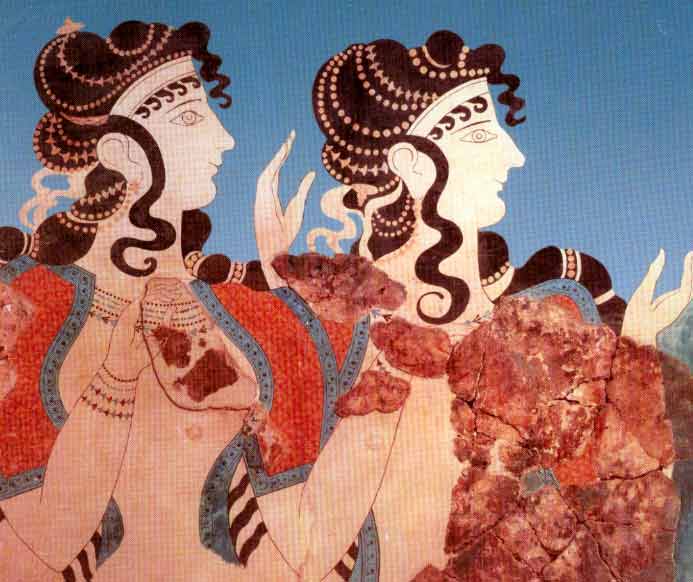
An exact copy of those painted in the marvellous frescoes of the Palace of Knossos, especially those depicting the proud Cretan women in their elegant attire: extremely elegant figures in dress and hairstyle – complex coiffures studded with strings of pearls or shells; pitch-black hair, large eyes, often made up, like the famous “Parisienne” (though it is not clear why she was given that name, since at the time there was not even a shadow of Paris or of Parisian women… but scholars, as we know, are original and creative).
Finally, at the sides of the head there are serpentine curls in the foreground… The women in one of these splendid Cretan frescoes are commonly called the “Ladies in Blue”, although, to tell the truth, it is the painted background that is blue, while the dresses – or rather the bodices with little boleros, with short puffed sleeves decorated with a braid of small blue waves – are red and finely embroidered… They fully display the breasts, which Cretan women used to wear bare. Reluctantly we leave Crete and return to our little Madonna, who never ceases to amaze us: it may be “chance”, but her dress too is red with small decorations, while her cloak is a beautiful blue.
To be continued…