The mysterious Glyphs of the Acropolis of Croccia
Archeologia – pubblicazione in preparazione
The mysterious Glyphs of the Ager Cuneatus of the Acropolis of Croccia, in the Gallipoli-Cognato Forest
THE TRIANGLE
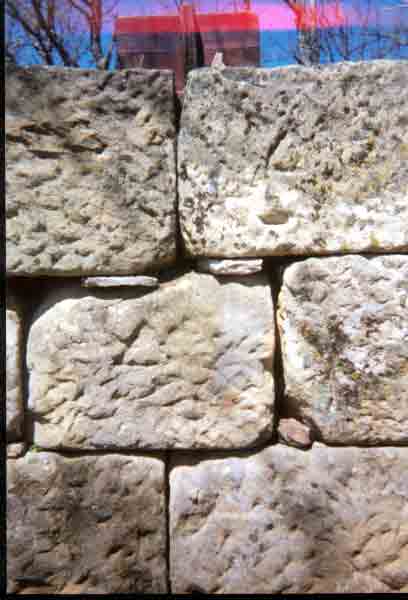
The second symbol we notice on the stones of the Acropolis of Croccia-Cognato is the Triangle, incised now upright, pointing upwards, now upside down. There are some both inside the circuit of walls and outside, to the left of the main entrance…
The Triangle is one of the oldest symbols, already used in the Palaeolithic. Gimbutas shows us, in a rare image, a triangular figurine carved in flint, in which a female form can be seen, dating back about 500,000 years and attributed to Heidelberg man.
In the Neolithic, in Brittany and in Ireland, tombs were built with large triangular stones, and their plan too was triangular. Sanctuaries generally had the same shape. At the important site of Lepenski Vir, in Yugoslavia, for example, a skeleton was laid on a triangle of red plaster, after being carefully folded so that the navel – considered the centre of the body and the gateway to rebirth – lay at the centre of the triangle. These precautions, together with the ever-present red colour, show that burial was inseparable from a precise ritual of regeneration: the tomb, that is, was considered nothing other than a womb (the uterus of Mother Earth) from which one would be reborn.
Red symbolised the power of the female blood of regeneration, the cyclical blood of the uterine lining, which that culture identified with life and rightly considered the only pure blood, deriving neither from violence, nor from illness, nor from killing. The sanctuary of Lepenski Vir itself, on the Danube near Belgrade, was built of large stone blocks and still has the shape of a great triangle. All around the sacred area, where the altar presumably stood, were stones also shaped like triangles with upward projections – a kind of upturned A, or a “delta” with projections on both sides… a horned triangle.
Here too the floors are of red plaster, dated to about 8,000 years ago.
Numerous triangular amulets in different materials – stone, clay, bone – are regularly found in tombs and caves, and also on loom weights, and the list could go on (cf. Gimbutas, op. cit., p. 238). But even without this evidence and the observations it leads to, one understands that the regenerative meaning of the triangle lies in its representing the vulva, the female pubis. This representation is everywhere in “most ancient antiquity”, and certainly not by chance.
The Triangle represented both a general abstract concept referring to vital power and fertility and a precise reference to the real feminine.
It is the pars pro toto, the part that stands for the whole, symbolising woman and her regenerative power, the earth, and vital power itself.
This depiction draws its greatest communicative force from the fact that it is not “naturalistic” but schematic, abstract – further proof of the “intelligence” of those ancient peoples, who expressed their concepts with precise and pertinent signs.
Indeed, most of the images from those remote times convey a sense of respect for life and for sexuality, specifically female, and consequently for the natural world; and this is perhaps the reason for that nostalgia for the “earthly paradise” which later cultures, having lost it, tried in various ways to return to, attempting to rebuild its memory through the most diverse myths…
To be continued…