Social Sculpture
Art that shapes life
Read The Social Sculpture, a hypertext book of 102 pages (in Italian).
(S)Cultura Sociale – an art that shapes culture and life
“Social sculpture as the most important art; as a system that transforms the whole social organism into a work of art” (J. Beuys)
The search for Harmony lies at the heart of all of Teri Volini’s work, ever since she exalted and magnified the beauty and generosity of Mother Earth through painting, expressing in the most vivid colour and the deepest shadow, in the cellular structure of her images and in the mysterious unveiling of visible and invisible worlds, an intense love for every form of life, human and non-human, and for the universe…
When, at the end of the 1990s, she began the fateful path that led her from painting – with which she had honoured her mission as a communicator of Beauty – to working directly in nature and in the urban environment through Performances and Installations large and small, the Artist was simply responding to the need to embody and exemplify a more intense, conscious way of living, respectful of all beings and of nature, in the awareness of being One with all that exists.
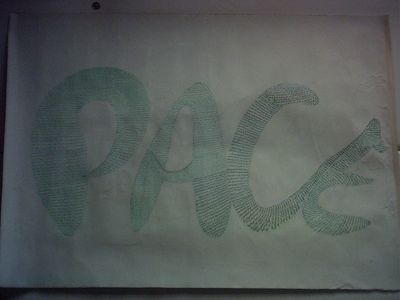
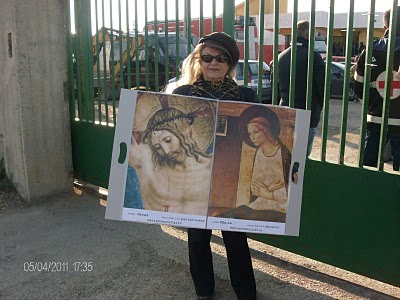
Little by little Teri gives names – forged along the way – to that expanded concept of art she practises “instinctively” and intensely: Participatory or Engaging Art, Body Art, Video Art, Textile Art, Writing Art, Land Art, Urban Art, Public Art, No Will Art, Channeling Art, Art for Peace…
With it she continues, beyond any stereotype – first by intuition, then with declared awareness – in the conviction that only a restoration of the true meaning of art can preserve it – and those who practise it – from decline, inevitable if it keeps following the lines and the diktats of a certain kind of culture, of which it is often servant and accomplice.
She feels she is on the right path: that of a redefinition of Art in Truth, Authenticity, Awareness and Beauty, in line with Life itself; the drive and support of a renewed consciousness, imbued with – and at the same time spreading – values fundamental to humanity.
That this may give art – and the whole of society – new strength and meaning becomes ever clearer to the Artist; and great is her joy when she finds important confirmation of it, not only in the vision of great thinkers, sociologists and enlightened economists, but in that of a great master like Beuys, who – as she discovered later – already in the 1970s advocated new and privileged possibilities for art, which he saw as closely connected with the spiritual and human development of each individual: Anthropological Art.
Prophetically expressing a revolutionary concept, Beuys spoke of an art that would shape culture and life:
a concept of Social Sculpture as the most important art; as a system that transforms the whole social organism into a work of art, including the whole process of work – Goya’s as well as that of agriculture, science, education, technology.
Where the principle of production and consumption takes on a form of true quality.
Not only the making of paintings and sculptures must be transformed, but the whole social form.
It is a gigantic programme.