The Awakening of the Goddess
Il Risveglio della Dea
Presented by Maria Grazia Longhi and Pasquale Totaro-Ziella.
The video
Song, Hierophany and Magnificence in the painting of Teri Volini
– Presence –
To start before the works. To feel drawn, to feel called: a decisive summons, an invitation to stop for a long time, to try to understand why those apparitions make such an impression. What is this breathing presence of theirs? It is not easy to put the vision into words, to write down the surprise, the pleasure: seeing, feeling and saying belong to such different orders; and here, to complicate the effort of defining, love also comes into play. To complicate it, since it is far harder to explain the reasons for what one loves, and why. What is presence, what is this reactive current that sweeps over us from the space of the painting and carries us backwards, to retrace the artist’s work, to share her anxiety and her compulsive, incessant search for depth? A vital tension, the same that made Cézanne say: “What I am trying to translate is more mysterious; it is entwined in the very roots of being, in the impalpable source of sensations.”
– Profusion – Magnificence –
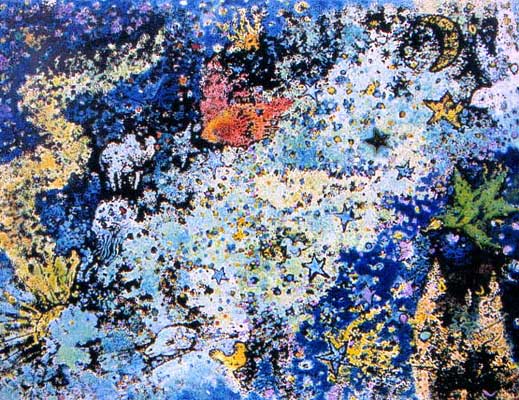
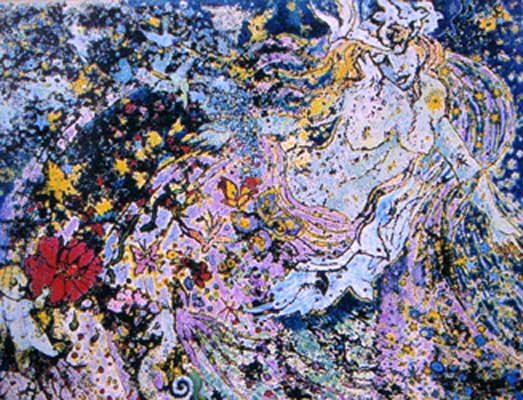
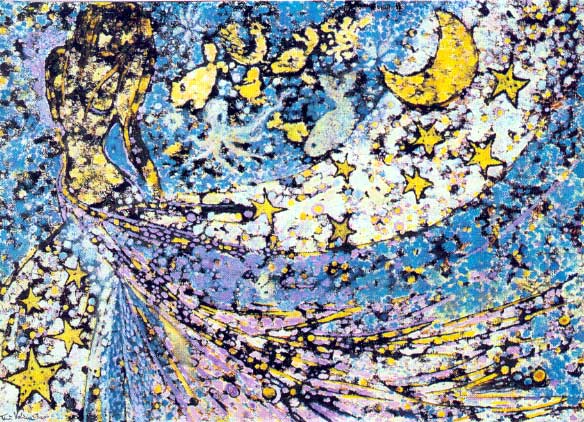
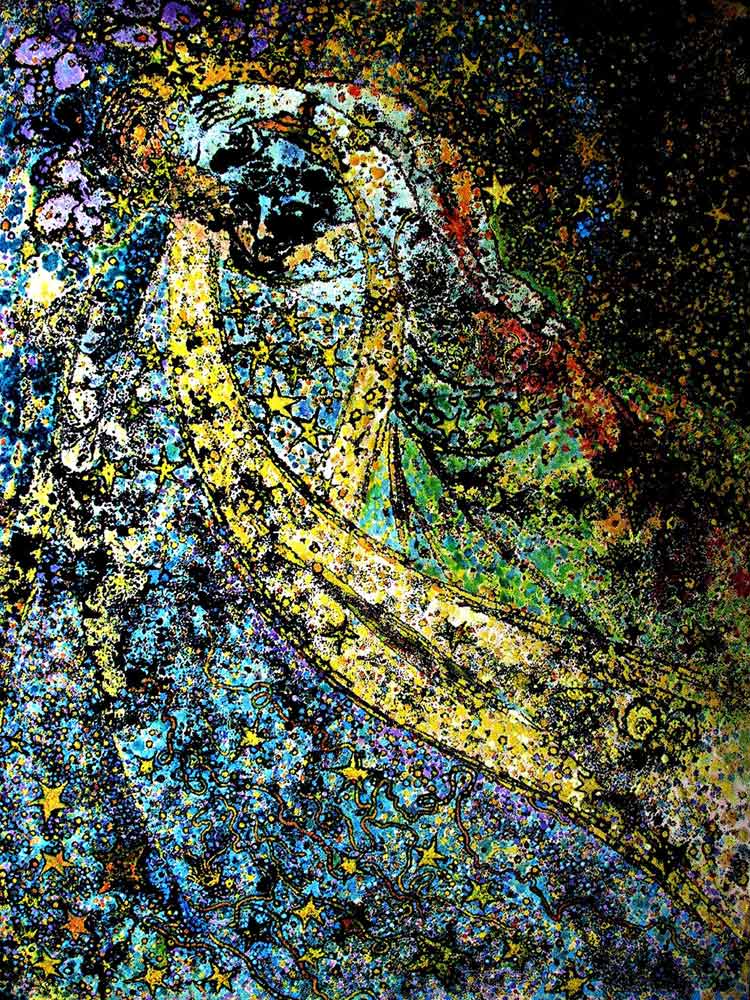
Teri’s painting leads us into the order of enchanted gardens or the Elysian Fields. Solar moons dazzle; the shafts of light of milky ways crossed by birds, flowers, fish, corals and… a goddess capture us; among the seaweed and the swarms of bees, beside the broom and the irises, beside and around everything there are stars; stars that draw everything into their implosion: theirs is a motionless effusion, a tender, playful whirl that produces in the viewer the sweetest effect of sideration.
In their firmament everything is rising, or falling, or remains suspended in a flow of dizzying proximity; every figure is a heteroclite whole, promiscuous, contiguous, manifold; every being opens to us the image of its communion with the others, every fragment is a microcosm of chaotic fertility; its surface is the ground of a figurative and chromatic deflagration that makes everything throb, and everything has its own original way of presenting itself – panic, I would say – its own timbre of voice: let us listen to them speak their special language, let us grasp the richness of tones, the colours and their harmonies, the lyricism; seeing will be like taking part in the unfolding of an endless and ever reinvented version of an inescapable topos of art history: what seduces us and returns us to the peace of contemplation, so that among things, and from things to us, the marvel of “the Sacred Conversation” is renewed.
– Saturation – Apparitions –
A proposed exercise, or a peaceful challenge: try to list, counting them to exhaustion and saturation, all the shapes that appear – the ovals, for instance, or the spheres, or just the five-pointed geometry of the star, with all its variations of number and size – and note its relations, its encounters; the same exercise for the figures of flora, marine and terrestrial, and of fauna, the so-called “real” kind and the kind from the nursery or the fairy-tale book; and, as you apply yourselves to the count, let the other apparitions gradually surface… a profile of mountains that is also a wave, or a breath of zephyr… the silent dance of butterflies or dragonflies, a metamorphosis of purple or violet flowers… white-blue nebulae, or a flight of doves, or a soft flock, a shining path, or, arched, the immense starry body of Nut…, a light silhouette… a woman… the goddess…? of incorporeal substance, of symbolic intent, an icon? … a fifteenth-century Primavera, a maiden from the memory of the dolce stil novo, a virginal presence or a Mother, a Madonna, a Fairy or a Witch…
A frontier between visible and invisible, a revelation of those states of dreaming wakefulness that the artist translates into painting, a “dreamed communication between Woman and the Supernatural” (R. Barthes).
– The Song –
The proposed enumeration will be like an exercise in asceticism, a mimesis of the liturgy that inspired the painting’s genesis; it will be the repetition of the hymn, a magnificat singing nature and its creatures together with the inventions of fantasy.
A canticle that imposes its rhythms – “Rhythm of the seaweed”, “Rhythm of the blue flower and girl, night”, “Rhythm of the infinite” – placing in the colours certain tones, certain notes, among them “the high yellow note” that Van Gogh called for.
– Colour – Porosity –
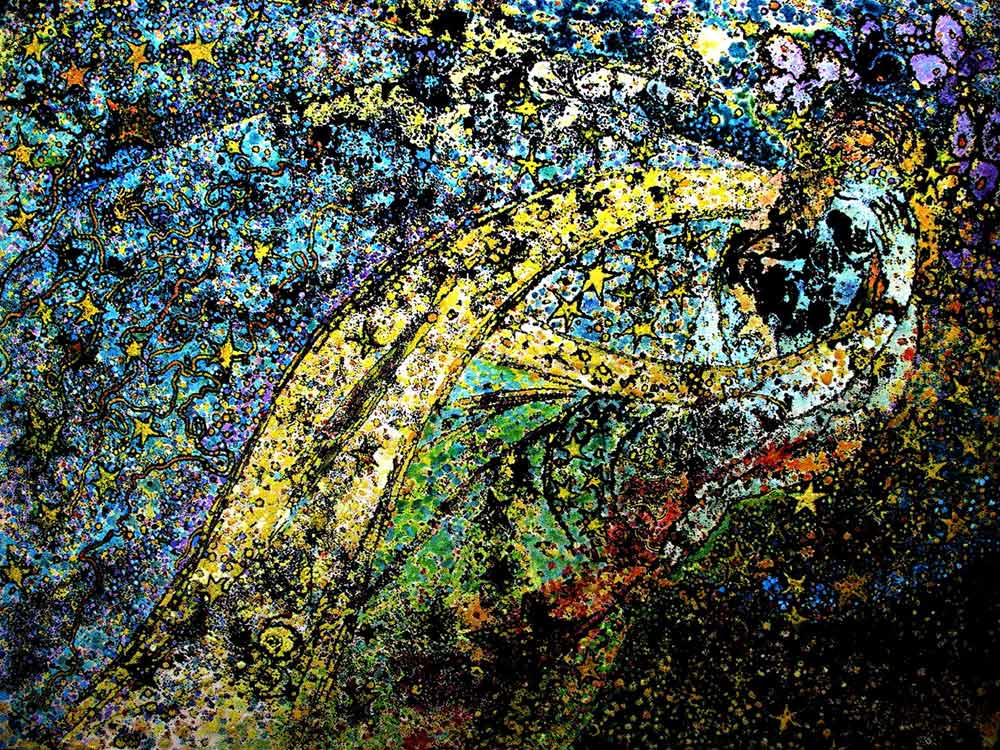
Equally brilliant is the spectrum of blues, the whole range of azures around which the presence of stars and sea seems to take shape, of peaks turning extraterrestrial, of heavenly bodies for which blue is very often also pink; it is a painting in sparks, a Lucretian universe of the most intense cellular activity, which explains the passages, the transformations, the frantic exchange of borrowings between atoms, the extraordinary porosity of Volini’s rerum natura; the broom has the blaze by which we recognise Venus, the meadows, the veils of dust and milk of the way that bears its name; day is crossed by the nocturnal lights of a black lit up by the nearby whites or yellows; the blonde nights shine with the glow of the sun.
– Picturae motus –
The pictorial matter is in motion, and the movement has the swift appearance of a meteor, the transparency of a comet, while at times taking on the thickness of an oceanic mass, the rush of a lava flow in the fury of an eruption. All the elements – water, air, earth, fire – gather in an overload of planes, so that we see each of their particles, in the form of shells, butterflies, seahorses, frogs, mermaids, plants, and the woman, advance into the foreground and at the same time withdraw into depth; everything holds still within the frame of forms outlined in black and at the same time is shaken by a vibration, inwardly animated by the quiver of the colours: the colours are the Word, it is they that carry the different faces of feeling, that suggest the plural of meaning and arouse emotion. This continuous jubilation is a wedding feast: all the elements marry, merge, become another element, the One, the only one – but which?
Do they transform, become, or are they? An echo, not too distant, comes from the realm of philosophy, recalling Heidegger’s “being” or the phenomenological “il y a”.
– A Hierophany –
The title of the exhibition, “The Awakening of the Goddess”, forces us to pass from objects to a precise subject. The exercise in declamation would not be complete if we overlooked a further definition of this painting: it is a hierophany, a manifestation of the sacred, which reproduces itself by passing from manifold space to the body – the female body – and from the self-generating values of creativity to the generative ones tout court, to Fertility. It is a hierophany that promotes the assumption of the woman’s body into a glorious body; celebrating its power to give and perpetuate life, it sacralises woman and sublimates her into a divine creature.
In every painting by Teri, and more openly in the latest works, there is the “illustration” of a grand fable; the signs of the new symphony of greens composed for The Awakening of the Goddess are worthy of universal mythology; they awaken nostalgia for a lost paradise, for a matriarchal golden age that most consider legendary but that she sees and treats as historically real.
– The Reward –
There is a reward at the end of this exhausting exercise of leafing through the details of the painting: it happened to me – and you, once the enumeration is over, don’t you feel more euphoric, don’t you feel something like, let us say, a surplus of energy?
Maria Grazia Longhi