The Path of Light
Il Sentiero della Luce
On Sunday 10 October 2004 the Urban Art event RiGiraLArte, organised by Sitart, takes place in Milan.
The artist Teri Volini presents the work The Path of Light, based on a path of rediscovery of certain ancestral symbols… on the manhole covers of AEM, the Milan Electricity Company, in via M. Gioia.
These signs are similar to the mysterious glyphs she had already traced in Basilicata, ancient Lucania, on the great stones of the Ager Cuneatus of the Acropolis of Croccia, Gallipoli Cognato forest, Park of the Lucanian Little Dolomites.
The rediscovery led the artist – as a researcher and mytho-archaeologist – to take up and develop a demanding piece of research begun long before which, starting from the study and decoding of the symbols, leads to important reflections on each person’s inner search.
In Teri Volini’s words:
“Experiencing this path of light can be the first step towards activating a new path, in which a significant flow of awareness is set in motion, accompanied by determination in pursuing rediscovered values: peace, harmony, beauty and fullness of life…
All that we need if we want a future for ourselves and for our children…
This rediscovery is of fundamental importance because it implies a change – by now indispensable – not only for the happiness of humanity but for the survival of the planet and of all beings…
The change consists in the passage from the deadly mode still prevailing to one that protects and develops life…”
This fundamental need is closely linked to the rediscovery and revaluation of the feminine principle which, by giving and preserving life, guarantees a different way of living…
The message… is that an effective age of harmony and peace may open, in harmony with the creative energies of nature.
Teri Volini
Article “On ancient stones in Basilicata and on manhole covers in Milan” by Teri Volini (in Italian)
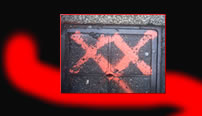

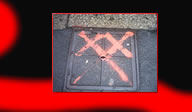

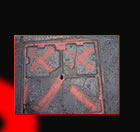


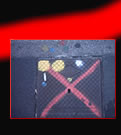






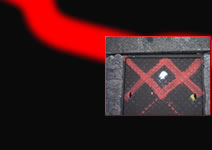

The Path of Light – from involuntary art to hierophany
Event: the Urban Art event RiGiraLArte organised by Sitart.
Place and date: Milan, Sunday 10 October 2004.
Route: from via M. Gioia, corner of via Galvani, to the Martesana gardens.
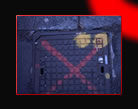
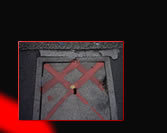
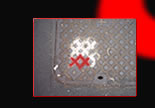
Work: the Signs traced on the AEM manhole covers along the cycle path.
Authors: the AEM workers and the artist Teri Volini.
Performance: a mytho-archaeological cycle-exploration of the AEM manhole covers and the finding of the Symbols in Joy (nella Gioia – a play on via Gioia, “joy street”).
The artist’s intervention: underlining and drips in red and gold on the Signs beyond the manhole covers, on the road surface.
Photographic exhibition, installation, dossier on the Symbols: in the Martesana gardens, at the end of via Gioia.
Mytho-archaeological research: from the mysterious glyphs of the Ager Cuneatus in the Acropolis of Croccia, Gallipoli Cognato forest – Park of the Lucanian Little Dolomites – to the AEM manhole covers in Milan.
Organised by Sitart, RIGIRALARTE
turns Milan into a building site “open” to creativity, involving streets, parks, squares, underground and railway lines, trams, architecture, artists, citizens and cyclists.
So commonplaces become anomalous when “mapped” with works of art, transformed into relative signals that overturn the perception of public space, prompting reflection and curiosity about its experiential potential.
The installations placed in the city’s symbolic places conceptually redraw the physical and flexible territory at the very moment when public space becomes the stage for works that interact with the artist and the viewer.
Jacqueline Ceresoli, art critic, Milan
Invitation
Inviting people to walk a Path of Light in the city of Milan – which shines, if anything, with shop signs, speeding cars and crystal-eyed giants?
The idea might seem quite odd, were it not proposed by an artist who believes she is fully aware of her own research.
And precisely she, who comes from the ancient land of woods and magic, Lucania – where paths are far more natural, rich in the shady charm of plants and dense with scents and mystery – is all the more intrigued to find one, and a path of Light at that, where one would least think of looking for it: amid the concrete, among puddles reflecting the grey sky after rain or soaked with greyish snow, in the streaked dust, in the unbreathable smell of traffic; on dark patches of tar, near petrol stations, among cigarette butts and crumpled cans, on the scored asphalt, among chewing gum and sandy soil blackened by smog; and… on manhole covers.
In this scenario – apocalyptic for anyone dreaming of a sunny, healthy, breathable world – she, who loves this city all the same, so much so as to have become a transhumant by choice, really did find that Path of Light…
It is a very special path and a very special light, as we shall see.
What matters is to propose it, so as to discover the features that make it so special…
No one could ever have seen this path from a speeding car: this kind of discovery requires… slowness; but also a particular attention, without which it cannot be identified even on foot.
RiGiraLArte offered a unique opportunity: visitors, cycling calmly along the via Melchiorre Gioia cycle path – and in any case along the route shown on a map – can make a kind of urban safari, an archaeological visit within the city, with the artist as their ideal guide…
Teri Volini, mytho-archaeologist
The feminine principle
The main aim of our research is the rediscovery and revaluation of the feminine principle as the bearer of values connected with giving and sustaining life.
These values are embodied and sustained by the Goddess, who symbolises the universal principle and is, in all her manifestations – in the cosmos, on earth and in all living beings – the luminous Energy, Source and Support of all that exists.
This rediscovery is of fundamental importance because it implies a change – by now indispensable – not only for the happiness of humanity but for the survival of the planet and of all beings…
The change consists in the passage from the deadly mode still prevailing to another that protects and develops life.
When we speak of the goddess-light, we do not refer only to her mythological image – present, moreover, in all the most ancient cultures – but to her metaphorical and real quality, which is the deep splendour inherent in each of us as beings of light, in search of the infinite greatness of our divine self.
There is no dichotomy: light refers to the real essence, to the beauty of what exists, and to that clarity, invoked by our mind, which – once regained – can radically change our lives, since we will be able to perceive that rediscovered preciousness fully and will no longer want to lose it…
Experiencing a path of light, then, can be the first step towards activating a new path, in which the symbol of the goddess brings a significant flow of awareness, accompanied by determination in pursuing rediscovered values: peace, harmony, beauty and fullness of life….
All that we need if we want a future for ourselves and for our children…
Teri Volini
With thanks to AEM in the role of Luci-fera = bearer of light
Re-seeing the invisible
The Symbol, the Myth, the Image belong to the substance of spiritual life; they may be disguised, mutilated, degraded, but they can never be extirpated. (1)
There are things in daily life that are so much part of our lives that they become invisible.
This is even truer in places like big cities, where haste, as a necessity and as a value, makes a relaxed and attentive gaze truly difficult… the only gaze that allows more authentic perceptions.
Then, one fine day, someone comes along who has time to waste: she looks with different eyes at that reality taken so much for granted, and sees something else; she receives confirmation, begins or completes research that goes beyond pure erudition and has much to do with the depths… perhaps with real knowledge of life and of the soul?
It would be lovely if each of us did this; unfortunately it does not always happen, and so…
if it is true that the artist sees what often escapes the common gaze, it falls to the artist to carry out this magnificent and demanding task: to discover hidden things, those that peep out, those that seem obvious; buried things that want to re-emerge, reappear, be heard again… and to bring them back to light, explore them, translate them into an understandable language.
It is the beginning of a complex work, which in this case takes place in a highly urbanised environment: and so the artist finds herself, tout court, an explorer in an asphalt jungle: the traces to follow are at the level of the road, of the pavement…
And it is in the dizziness of the very tall glass towers that her vocation as a mytho-archaeologist is confirmed.
It is in the city of concrete that she finds herself – as she was already doing in ancient forests and on Cyclopean boulders – a discoverer of mysterious signs, whose essence she then sets out to decipher and communicate.
…..
The starting point of this path is singular, to say the least: the artistic Work is represented… by the AEM manhole covers in via M. Gioia, and its material authors are the workers of the Milan Electricity Company.
Via Gioia is not the only place where the finds can be seen.
But let the artist herself speak:
“I had noticed these signs in the city for some time, on various manhole covers – first in via Padova, near the stops of the number 56 bus, then around the Central Station…
I was immediately struck by them, since at that very time I was working on a new draft of research – begun long before – on the mysterious glyphs, the incised signs found on the Cyclopean walls of a very ancient archaeological site in ancient Lucania, my native land: the Ager Cuneatus in the Gallipoli–Cognato forest….
The complex usually called the Acropolis – clearly outlined by the surviving walls, with its entrance still visible – and what must have been the settlement, of some importance given the other gates in the southern wall, where one can imagine a large arch that later collapsed, stood on a height.
The level ground that held the dwellings, or perhaps a temple, or whatever else, was triangular, that is, ‘wedge-shaped’.
This shape is probably the origin of the name Ager Cuneatus, or wedge-shaped field, and of the singular assonance with the later name ‘Cognato’.
These walls date back many millennia, and the erosion of the stone has ‘camouflaged’ the signs; moreover, perhaps because of a lowering of the ground level and of the walls, the glyphs are positioned rather low, sometimes just a few centimetres above the ground.
In this place:
The mystery of our most ancient origins seems to peep out through strange signs on stone. Sometimes with simple lines, sometimes with dotted incisions – the glyphs – small geometric figures emerge before our eyes: mostly triangles, pointing up or upside down, but also the circle, the X and the double X, the lozenge and, finally, dots and a kind of H. (2)
I could not believe my eyes: before me, under my feet, the very archetypal symbols I was analysing had appeared.
So I began to take photographs to confirm the reality of that ‘find’, but as chance would have it, almost all of them were lost when they were printed.
When the organiser of RiGiraLArte invited me to take part in the event, those forgotten signs on the manhole covers of Milan instinctively came back to mind – I did not even know whether any traces remained: so I returned to the Lombard city specially to find them again and photograph them… and to make of them, and through them, my work.
It was 7 August: I had to choose a suitable route, make a map so that visitors could find them in turn and, first of all… find the signs again and photograph them.
I was dismayed: they all seemed to have disappeared…. Had I dreamt them?
I found myself in via Galvani and from there in via Gioia.
The signs were there, waiting for me… I understood that I could do the work, and that this was only the beginning…
In those two streets with synergetic names (Galvani, the scientist of electricity, and Gioia, joy) the heat was stifling: when I had finished the survey, decided the route and taken the coordinates for the visitors’ map of the ‘exhibition’, I was exhausted; I took the photos almost in the dark… but there was a lot of light outside and within me.”
Teri Volini, The mysterious glyphs of the Ager Cuneatus in the Acropolis of Croccia, Gallipoli Cognato forest – Park of the Lucanian Little Dolomites, mytho-archaeological research
Symbols
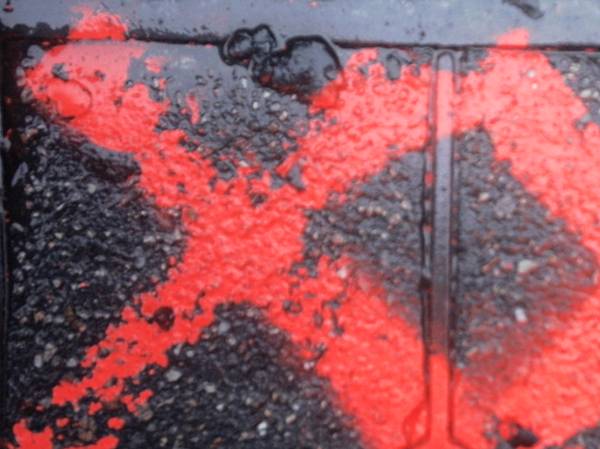
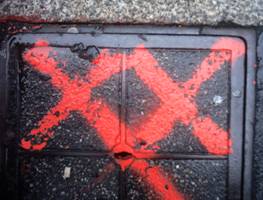
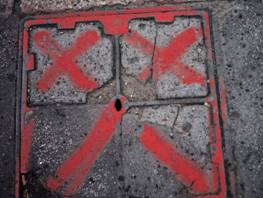
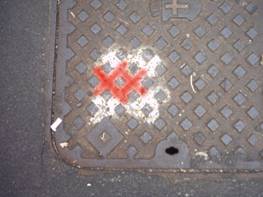
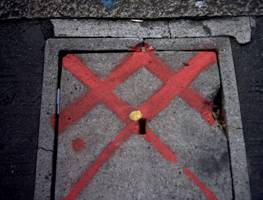
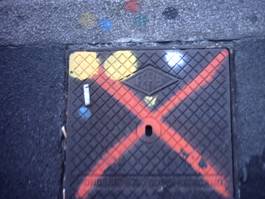
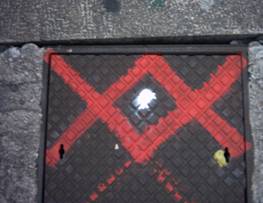
Signs have been placed on the manhole covers, in which the predominant colour is red; there is also some yellow, white, blue and light blue, in small quantities…
But what, in the end, are these mysterious signs?
Let us reveal the first, simplest secret at once: they are X shapes, double Xs, lozenges and dots… and more Xs, triangles and circles along the route, on the road surface.
Is that all? – the astonished readers will think – And on ordinary manhole covers, to boot!
Thank goodness they’re not the sewer ones! Honestly!
It’s really true that artists are strange people!
And then, what a nerve – using work done by others and even showing it as a work of art, without working, without making any effort!!!
It’s the limit!
Indeed, the symbols were “drawn” by AEM…
The workers of the Milan electricity company were the authors of the work.
Involuntary operators, however, since in carrying out their job they traced identification or signalling marks useful to the electricity company.
But with that gesture, without knowing it – and without any need to know it – they became the medium, the vehicle, of a symbolism of very complex meaning.
Though they were not aware of it at the time, they were the precious instrument of a rediscovery; the guided transcribers of a powerful message…
Being in reality bearers of light, they brought about a hierophany.
Hmm… – the readers will retort – for now we’ll ask what this last statement means; and anyway, if the people who did the actual work were the AEM workers, then this is involuntary art!
And in that case, can the artist still have an active role, or does she lose the right to present the work as hers, since she did not make it materially?
Let us ask an insider, Tiziana Musi, a lecturer at the Academy of Fine Arts in Rome – protagonist, together with Rossella Gallo and students of the Academies of Rome and Naples, of a very interesting experience on this subject, presented at the gallery La Porta Blu in Rome. For her, speaking of involuntary art rightly raises a contradiction in terms, since art seems to imply activity, planning, manual skill, technique and so on.
Musi nonetheless admits that… art is not only planning, thought, idea, but also finding, in what seems most distant, the sign of an emotion…
According to her, art has always been a privileged tool for bringing the invisible to the surface, but one can also show what is already visible – you just have to know how to look for it…, since it is possible to observe with a different gaze what belongs to an everyday life you do not notice…
We seem to understand, then, that there can indeed be art in this withdrawal of the artist from making the work, and in taking on another role – no less important – which consists in a different, and certainly sharper and highly aware, way of observing reality.
One can make use of the involuntary, the unconscious, to arrive at awareness, at knowledge…
We thank Tiziana Musi for her valuable contribution and reassure the most demanding visitors: the artist too makes her own manual, personal interventions, both along the route – on the road surface – and at the end, in the arches of the Martesana gardens: a photographic exhibition, a frottage and an intervention on the wooden fences with the red ribbon that is her stylistic signature. (3)
But her strongest commitment will be that of trans-lator, in the original sense of the word, as the dictionary suggests: she who carries across, carries beyond, lets pass, transfers, leads beyond, induces.
Who, what and how, we shall see later, if she succeeds…
For now: it is true that the workers traced the symbols, but… the signs are mysterious, the code has become alien, the writing is encrypted, the message risks being incomprehensible.
And this is where the heroic journey begins.
…
Before setting out, we fortify ourselves by reading something very interesting on the subject, by Mircea Eliade, the Romanian writer, philosopher and historian of religions:
Life is teeming with forgotten myths, decayed hierophanies, abandoned symbols…
The uninterrupted desacralisation of modern man has altered the content of his spiritual life, but it has not broken his imagination: in poorly controlled areas, a whole mythological history survives…
This mythical treasure lies there, “secularised” and “modernised”… degraded and disguised…
Powerful symbols have suffered what happened, as Freud showed, to overly explicit allusions to sexual realities: they have changed form, they have become “familiar”…
Their interest has not diminished for that, since these degraded images offer a possible starting point for spiritual renewal…
It is of the greatest importance – Eliade continues – to rediscover a whole mythology, if not a theology, concealed in the most “ordinary” life of modern man: it is up to him to swim back up the current and rediscover the deep meaning of all those faded images and degraded myths…
He is free to despise mythologies, but that will not stop him from continuing to feed on decayed myths and images – however degraded… (…)
All this pertains to a new humanism and a new anthropology. (4)
Yes, it is true: despite our well-cultivated ignorance, despite inattention and superficiality, the power of an archetypal image is such that it appears in the most unexpected ways, as in our case…
(1) Mircea Eliade, Images and Symbols. (2) From Teri Volini’s research on the glyphs of the Ager Cuneatus. (3) See the performances. (4) Mircea Eliade, op. cit., pp. 20–22.
For the description and decoding of the symbols see the publication: Teri Volini, I misteriosi glifi dell’Ager Cuneatus nell’Acropolis di Croccia, foresta di Gallipoli Cognato – Parco delle Piccole Dolomiti Lucane, mytho-archaeological research, Delta Edizioni
The route map
These directions may be useful to cycle-visitors to:
a) follow the traces along the path of Light;
b) recover the finds “in Joy” (via Gioia).
The finds bearing archetypal symbols are mostly on the AEM manhole covers, mainly along the right and left edges of the cycle path.
Start of the route: the junction of the synergetic streets Galvani and Gioia, on the right.
Main finds
- by the newsstand: manhole cover with a blue X and yellow dots
- by the Esso service station, after the car wash: manhole cover with a light-blue X and yellow dots (photo)
- at no. 50: manhole cover with an X and dots
- at no. 54: manhole cover with a red double X and a white dot in the central lozenge (photo)
- at the Sondrio bus stop, in line with the church: manhole cover with a red double X, the lower lines growing, and a “corpus luteum” outside the central lozenge, almost in the middle of the main crossing of the lines (photo)
6/7. a little further on: manhole cover with a red double X; a little further up, another double X with dots
8/9. at no. 64: manhole cover with a yellow dot; corner of via Sondrio, underground station: dots - at nos. 74–76–78: a whole series of red XXXX
- at no. 82: a red triple X
- at no. 84, at the start of the cycle path, right side: a series of 9 triangles – the artist’s intervention in red and gold
- at no. 86, in front of Amadio: a whole series of Xs on several levels
- at no. 88: a red X with two yellow dots plus dots of various colours, yellow, light blue, white (photo)
- by the Banca Popolare Veneta: two red Xs with dots
- at the junction with via Zuccoli: manhole cover with a white and rust concretion and the artist’s intervention in red (photo)
- after the junction, along the cycle path: 13 circular holes in a row, the artist’s intervention in red and gold
- D. Tessera gardens: photographic exhibition, installation and dossier on the archetypal symbols
I wish everyone a luminous journey.
Teri Volini