Revelation
Rivelazione
Living art in everyday experience
Various places, Milan, May–July 2001
Various places, Potenza, December 2001 – February 2002
As my research on the Veil continued in all its many-sided richness, I decided to put on the Veil, thus creating a Symbolic Action in which I use my physical person as an expressive medium: a form of Body Art in which the Artist’s body is in itself the Work, the visible instrument of communication;
a living Work in the strict sense, since it breathes, speaks, walks and moves among people, offering observations and accepting reactions and reflections – in short, creating inter-action, dialogue, research and deeper study on important and tragically topical themes.
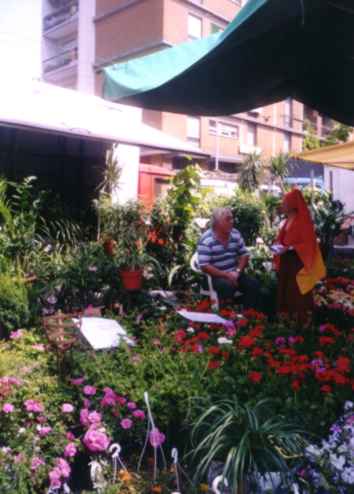
By wearing the Veil – as I have been doing since December in Potenza, and as I did from May to July in Milan, in various places and situations, and later in Calabria, in Tropea – I wish to highlight some fundamental issues, including:
- expressing solidarity with women oppressed by fundamentalisms of every kind: denied women, forced to wear the veil, forced into silence, forced into invisibility… In short, re-veiling myself to remember that we must lift the veil of ferocious patriarchy, but also that of our indifference.
- highlighting the scandalous persistence of a Veil that is invisible but present in our own culture too, which pretends not to see it: the veil of conformism, the veil of unawareness, the veil of silence imposed on those who do not conform to the dominant culture.
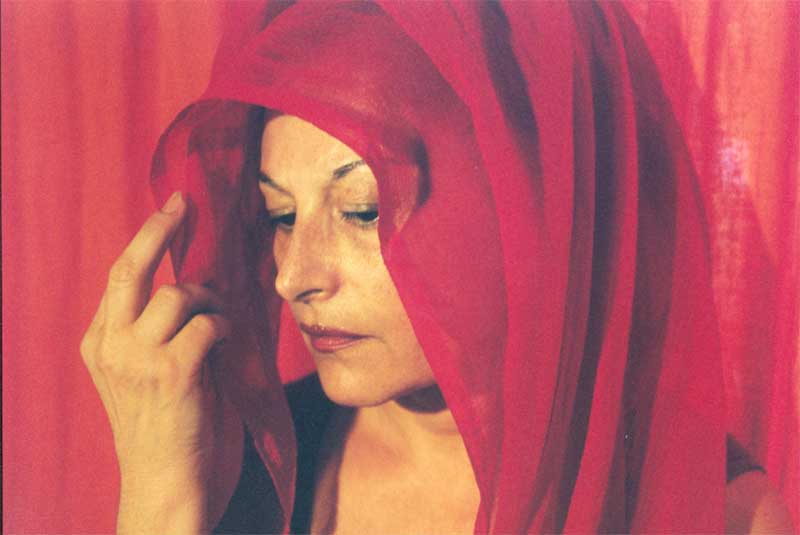
The revolutionary power of art
RI VEL AZIONE – a Symbolic Action by TERI VOLINI in Participatory Art.
As an artist and cultural organiser, I think practices of knowledge and awareness can be strongly encouraged by art.
This happens when we do not simply show fixed images of a static reality, but weave a web of intrigues and questions that stimulates critical thinking, promoting a new attitude towards mental habits and conformism.
By WEARING the VEIL I carry out an action in which the revolutionary power of art is especially visible since, by emphasising reality and “exaggerating” behaviour, it sets off processes capable of bringing about personal and social awareness.
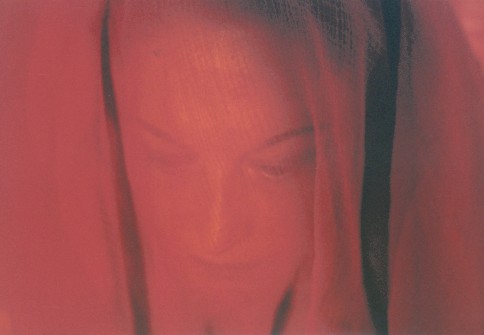
The title of the performance, RI VEL AZIONE (Re-vel-ation), expresses the desire to know through unveiling: to understand reality better by removing the veils that cover it, the veils that often cloud our minds…
But if we read re-velation as “the action of putting the Veil back on”, we could interpret the performance as a search for other meanings, different from the known ones, in order to overcome prejudice and limitations.
The reward for this new and more creative attitude on our part will be the discovery of the enormous richness of the Veil, one of the most living archetypal symbols, which – as often happens – has been usurped on one side and manipulated on the other by the culture dominant at the time, to the point of overturning its original meaning and erasing or hiding its richness…
As with many other terms, the perception of the “Veil” is in my view severely limited, stuck in a series of negative attributions which do correspond to dramatic realities – that of women under Islamic fundamentalism in particular…
Yet the negativity does not belong to the veil itself, but to its being compulsory, which makes it a terrible instrument of oppression, a uniform of belonging to fundamentalism…
Ri vel azione in Milan
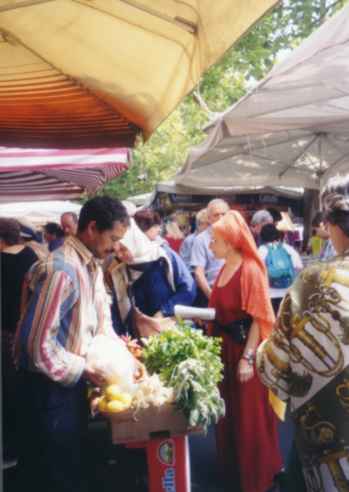
In May 2001 I wore the veil in Milan, everywhere, in everyday life, starting from the street where I live, via Padova – ever more a place of non-EU immigration; Trotter Park, where you can meet veiled women bringing their children to the swings; the underground, the street markets, where it is common to see women in black burqas silently doing their shopping… but also the city centre: Corso Vittorio Emanuele, Piazza Duomo, Parco Sempione; the cinema, the theatre, concerts, libraries…
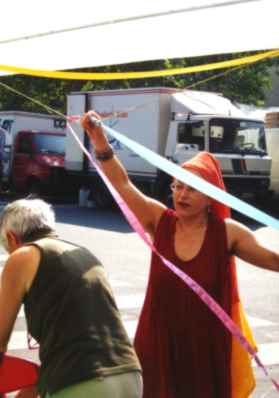
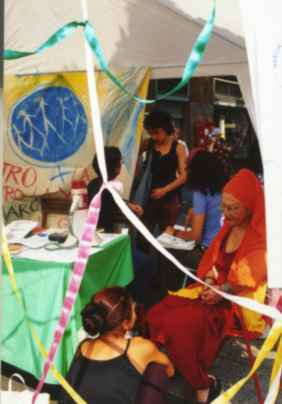
Living art in our everyday experience
The symbolic action, in which I – as the artist – am personally active, consists of wearing the veil everywhere in daily life, indoors and in the street, rather than on a particular occasion or in a set place (which may come later, with a photographic exhibition, a performance and the presentation of the research…).
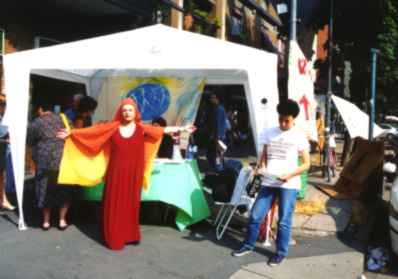
Very moving moments were lived especially during the women’s march for peace, the demonstrations of the Women in Black, the Liberation Day celebrations, the opening of S. Bonello’s exhibition at the 10-2 gallery, and the presentation of Assia Djebar’s book at the Province of Milan.
Particularly significant moments were the performance with Marina Abramović, the meeting in the lounge of the Galleria Vittorio Emanuele with Zecchi and Fiorucci… and getting to know Ida Magli…
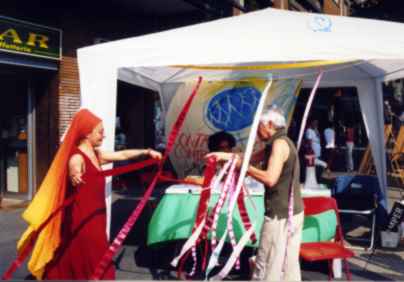
In daily life I gathered the reactions of “ordinary” people, whose remarks I recorded on the spot: the Egyptians in the shop below my home who sell delicious sour milk, people in department stores, at the fair-trade shop, at the via Osoppo market where, with other women weavers, we set up a real information point on weaving new relationships based on the values of peace and understanding between peoples.
A poetic act
I had wanted to carry out this performance for a long time: at first it was an instinctive need; now it has become a conscious and illuminating poetic act, with the precious support of interesting research.
I wish to offer the broadest possible vision of the VEIL, doing justice to its many-sided symbolic richness, through a journey in space and time… full of surprises, in which all those who wish can take part, even just with their curiosity, their intuitions and – why not – their doubts and perplexities. It is extremely interesting to encourage direct contact with all those who want to interact, ask questions or share their impressions…
These first reflections on the subject can be followed by a phase of further study.
Responsibility
I feel a great responsibility in carrying out this “action”, because it is not about playing a part or performing… but about going deep into oneself, understanding, and trying to communicate what one has learned. And interacting.
What I can guarantee is the seriousness of the research and an attitude of great respect for all the women for whom the veil – because of its patriarchal added value – still represents something terrible and dramatic: I am convinced, on the other hand, that only by speaking about it freely can we do something for them too. And, of course, understand ourselves better.
Teri Volini