Weaving in antiquity
La tessitura nell'antichità – Arte e artigianato
The symbolism of the rugs of Old Europe and Anatolia
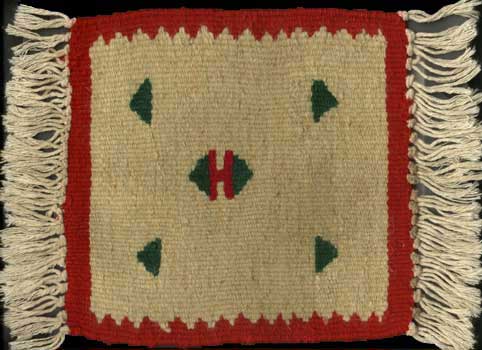
Let us return, then, to our glyph, the H. If we were still not convinced of the stylised power of its meaning, here is another little rug, again of Balkan weaving. It is even tinier than the others, a real soft-rough little tile: raw wool, not chemically treated. And what else could we find in it, you may ask, exhausted but curious?
Starting from a base, this time brick-red, which begins just after the white cotton fringe, we enter a mottled creamy-white field: it looks like sand, it makes you want to touch it, to stroke it… it is almost empty, there are only four little green triangles and, in the middle, another pair of green triangles… separating.
At the centre, between the two green triangles, stands out a beautiful red H.
It is a real “scarlet letter”.
As if to say: if you really don’t want to see – says the little rug – then don’t, or rather: since you are so blind you cannot see, I’ll put it right in front of you, and in the most striking colour too!
At this point there is no longer any doubt: the H is truly the representative, aniconic sign of LIFE. The frame, printed thousands of years ago by the hands of women who, while weaving, transcribed their culture, described inner impulses, gave form to their deep intuitions, depicted their genetic fields, their physiology, the prerogatives they had; they spoke through primordial images of what for them was the norm, what was socially held important and gave them authority: the privilege of giving and sustaining life…
Not yet inhibited by patriarchy, simple in their willingness to “tell”, women transmitted through weaving – the everyday form of representation, beyond the practical use of the objects – precious information coming directly from their cells, from their DNA. Later, with the fierce repression that followed, when women could no longer be the honourable and honoured protagonists of a mother-centred society, those images were transmitted in silence…
The images representing original female power, degraded and demonised by patriarchy, were carried on clandestinely, disguised as harmless “women’s work”. Indeed, it was precisely the lack of understanding that allowed them to survive.
Back to the images: observing now, in Anatolian rugs, the figured sequence – separating triangles plus separating triangles, vertically – we notice that the negative space… is again an H, and a very marked one!
To sum up: the lozenge represents the original unity, the matrix in which life is formed; the separating triangles, multiplication; and on those little rugs there is the “zoom” on the “fateful” moment of the first cell division, the drive to grow; the H is its stylised synthesis…
To be continued…